












GEO stands for Generative Engine Optimization.
Where does GEO come from?
The term was used by the researchers at Princeton, Georgia Tech, and IIT Delhi in their 2024 paper “GEO: Generative Engine Optimization.” They proved that rewriting pages to include statistics, quotes, and references could increase visibility in the results of the generative engines by 30-41% and even significantly higher for the lower-ranking pages.
That’s how the GEO term originated as an academic term. And the marketers just appropriated it the way they did SEO.
It is the process of ensuring that the brand and its website will be featured in the AI-generated response which includes the summary given by ChatGPT, Perplexity, Gemini, Claude, Copilot, and Google AI Overview/AI Mode, rather than appearing as a blue link in the search result pages only.
How does GEO differ SEO?
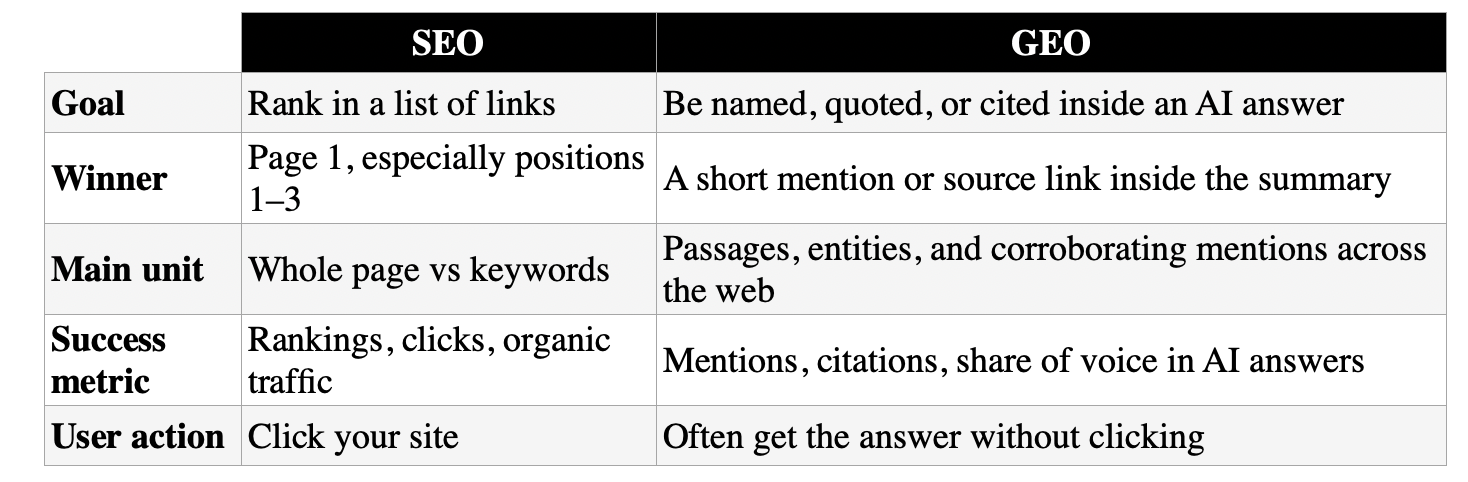
Even for GEO, SEO is helpful since there are several AI engines pulling content from the indexes on Google or Bing. This isn’t a competition of the same type. A piece of content may have a good ranking yet never be quoted. Also, it might be quoted even if it’s not part of the top 10 results.
The relationship between GEO, AIEO, and AEO
Common terms use in content marketing strategies:
SEO – stands for search engine optimization (Google, Bing). AEO – Answer Engine Optimization, in most cases it means winning featured snippets, AI Overviews, etc. GEO – optimize content for the generative engines that create an answer from different sources. AIEO – your term, meaning AI Engine Optimization, performs the same task as GEO/AEO yet focusing on the recognition of AI engines.
In reality, GEO and AIEO are the same field. AEO is a smaller segment of them.
How does GEO work?
It enhances how search engine bots to crawl the website.
- Create content that has an answer within a 40-word span.
- Include facts, dates, authors, and sources on the website. -Cover the entire subject rather than one keyword. -Be consistent with your company's name and facts online. -Generate backlinks from other reliable websites, lists, and videos. -Track if ChatGPT, Gemini, Perplexity, and Google AI bots talk about you.