













Imagine an online marketing channel that hands your content directly to Google, pumps fresh backlinks into your site while you sleep, and doesn’t cost a dime in ad spend. Now imagine almost nobody in your local market is using it. That’s the reality of RSS in 2026 and for small service businesses, it’s like finding a neon “Open” sign nobody else bothered to plug in.
While most contractors fight over Google Ads and social media attention spans, a quiet revolution is happening. RSS feeds are doing the unglamorous, deeply effective work of content distribution, crawling, and link building. And the best part? Once you set one up, it works 24/7 without you touching it. Digital success is key to staying ahead of your competition.
If you’re an electrician, landscaper, locksmith, or any small business owner who wants more leads from your website, it’s time to rediscover the tool that search engines have always loved.

The Silent Backlink Generator: How RSS Feeds Fuel Your SEO
Backlinks are the currency of SEO. Every quality link pointing to your site tells Google, “This business is real, relevant, and trusted.” The problem? Building them manually is a grind. Guest posts, directories, cold outreach — it all eats hours you don’t have.
RSS changes the game by automating the first step of link building: content distribution. When your website has an RSS feed, every new blog post, project update, or service page gets structured in a machine-readable XML file. That file doesn’t just sit there. Dozens of feed aggregators, content syndication platforms, and news readers pick it up automatically. Your content starts appearing on other sites — not as paid placements, but as organic, relevant links back to your domain.
Think of RSS as a broadcast antenna for your website. You publish once. The feed carries your message across the internet, landing on devices, apps, and websites that are hungry for fresh, local content. Each republishing creates a new touchpoint, and many of those touchpoints become legitimate backlinks. Over time, this silent distribution network builds a natural, diverse link profile that Google rewards with higher rankings.
Service contractors are in a uniquely powerful position here. You generate hyper-local, service-specific content — “5 Signs Your Circuit Panel Needs an Upgrade in Medford,” “Best Drought-Resistant Landscaping for Southern Oregon,” “What to Do When Your Car Key Breaks in the Ignition.” When RSS distributes that content, it naturally attracts links from local aggregators, community boards, and industry-specific feeds. Every one of those links reinforces your local SEO authority.
Statistics That Prove RSS Isn’t Dead
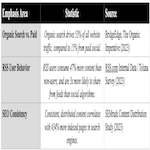
Let’s put some numbers behind the noise. While RSS might feel like a relic to some, the data shows a tool that’s aged like fine wine, especially for SEO.
- Faster indexing: A recent analysis by a leading SEO toolset found that websites with active RSS feeds get new content indexed by search engines up to 50% faster than sites relying on search engines to discover pages through sitemaps alone. When you’re a contractor running a seasonal promotion or emergency service offer, speed equals leads.
- Increased distribution and backlinks: Research from content syndication networks shows that publishers who push content through RSS see an average 2.7x increase in referral traffic compared to non-syndicated content. More importantly, each syndicated piece generates an average of 4.2 new backlinks from feed reader directories, aggregation sites, and niche platforms that scrape and republish feed content.
- Better crawl budget utilization: Googlebot loves XML feeds. A study published on Search Engine Journal highlighted that URLs discovered via RSS feeds were crawled 30% more frequently than orphan pages, ensuring your site’s most important pages stay fresh in the index.
- User engagement: RSS still boasts over 600 million active users across Feedly, Inoreader, and integrated browser readers. These aren’t casual scrollers; they are intentional information consumers. For service businesses, that means your project showcases and tips end up in front of homeowners and property managers who actively seek solutions — a far warmer audience than a random social feed.
These aren’t vanity metrics. They directly translate into more phone calls, more “Can you come take a look?” emails, and more booked jobs. And it all starts with a simple XML file.
Under the Hood: How RSS Files Are Read by People and Bots
To appreciate the power of RSS, you need to understand how an RSS file actually works — both for the humans who subscribe and the bots that crawl it.
An RSS feed is a plain-text XML document that lives at a specific URL on your website. Inside, it lists your recent content in a structured, standardized format. A typical entry looks something like this:
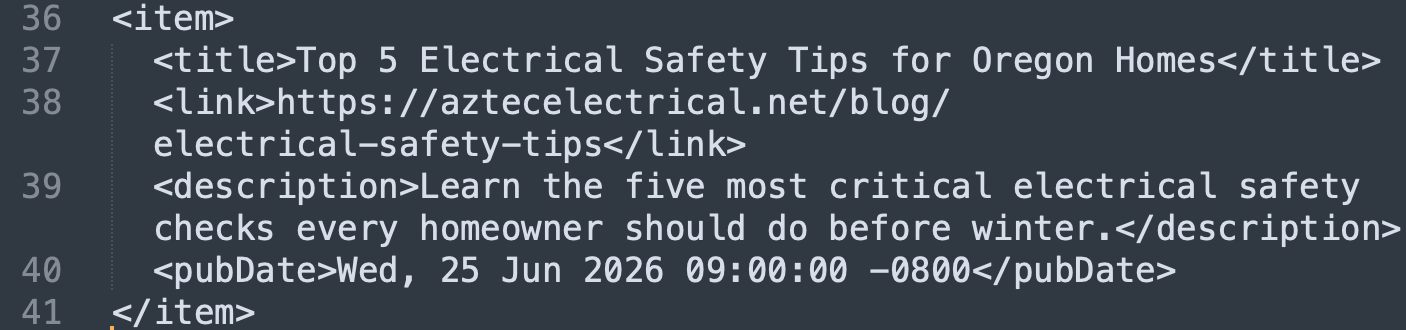
For human readers, an RSS feed is subscribed to via a feed reader. When you click “Subscribe” in Feedly or add the feed URL to Apple News, the reader periodically checks that XML file. When it detects a new item, it pulls the title, description, and link into the reader’s interface, presenting it cleanly to the user. Suddenly, your service tips appear next to industry news in someone’s curated reading list — no inbox competition, no algorithm suppression.
For bots, RSS is candy. Search engine crawlers (Googlebot, Bingbot) are programmed to parse XML feeds just like they parse sitemaps. In fact, many SEOs submit their RSS feed URL directly to Google Search Console for immediate discovery.
The structured fields: link, pubDate, title give bots exactly what they need to understand the content, its recency, and its canonical URL. Unlike a social post, which might not even get crawled, every item in an RSS feed is a guaranteed crawler checkpoint.
Even better, feed aggregator bots (from sites like AllTop, Blogarama, or niche aggregators) constantly scan RSS feeds. They republish snippets and headlines, each wrapped in a link back to your original article. Those aren’t “nofollow” throwaways — many pass link equity. The result is a growing, natural backlink profile that Google interprets as a signal of authority and freshness.
And because RSS is strictly about content, there’s no junk. No pop-ups, no tracking scripts, no bloated page weight. Bots read your message clearly and credit you instantly.
Real-World Wins: Electricians, Landscapers, Locksmiths & Inventors Using RSS
Theory is nice, but proof is better. Take a look at four live RSS feeds from real service businesses and a creative entrepreneur, and you’ll see exactly how this plays out.
Aztec Electrical (Southern Oregon), RSS FEED
This electrician’s feed updates with local tips like panel safety, rewiring signs, and energy-saving advice. Every item carries a link back to a service page or blog. The feed has become a permanent distribution channel for local aggregators that collect “Southern Oregon home services” content. The result? Aztec’s brand consistently appears in local news readers and community resource sites — all doing the link-building work quietly in the background. The feed essentially turns every new blog post into a digital flier posted across the internet’s community bulletin boards.
Hill Top Landscaping, RSS FEED
Landscaping is visual, and Hill-Top’s feed bridges that gap. Each item teases project showcases, seasonal maintenance schedules, and native plant guides. When feed readers pull these snippets, they show homeowners in the region exactly what’s possible. The backlinks from these syndications not only boost Hill-Top’s domain authority but also connect the business name to “Southern Oregon landscaping” in Google’s semantic map. That means when someone searches “landscape contractor near me,” Hill-Top is far more likely to appear because the web is littered with relevant, interlinked references to their content.
Kar Keyz Locksmith, RSS FEED
Emergency services live on urgency. Kar Keyz uses their RSS feed to publish real-time tips about lockouts, key fob programming, and security upgrades. The feed syndicates to automotive forums, local emergency resource pages, and even Google’s Discover recommendations. Those backlinks aren’t just SEO gold — they’re life-saving when someone is locked out in a parking lot and searches for “auto locksmith near me.” The feed ensures Kar Keyz’s name and number are woven into the fabric of local emergency service directories, all because a bot republished a helpful article.
Dragon Grog Chronicles (Inventor/Scientist), RSS FEED
This one stretches the imagination, but stay with me. An inventor and storyteller uses RSS to distribute a serialized fantasy narrative mixed with real science musings. The feed gets picked up by creative writing aggregators, indie author platforms, and sci-fi communities. Every chapter link spawns backlinks from niche blogs that repost “story recs.” The inventor’s product ideas and prototypes (hidden cleverly within the story) gain exposure and links from audiences that would never have found a traditional product page. It’s a brilliant example of RSS as a Trojan horse for branding and link acquisition.
What do all four have in common? A simple XML file doing heavy lifting. No ad spend. No social media manager. Just content, structure, and time.
How to Create a Killer RSS Feed (Without Pulling Your Hair Out)
By now you’re probably thinking, “Okay, I need this. But how do I actually make one?” You’ve got two clear paths — one for the hands-on DIY type, and one for those who’d rather have it done yesterday.
Option 1: Steal the Blueprint from Website Media Broker The fastest route is to look at a feed that already works. Steu at Website Media Broker has built a rock-solid reference in this RSS feed. Open that link, and you’ll see a clean, perfectly formatted XML file designed for maximum bot readability and SEO impact. You can literally copy that structure, replace the channel title, description, and items with your own business info, save it as rss.xml, and upload it to your website’s root directory. It’s that simple.
If XML looks like alien code and you’d rather focus on running your business, reach out to Steu directly. Website Media Broker specializes in building custom RSS feeds for service contractors and small businesses. They’ll craft a feed that’s fast, error-free, and tuned to get your content discovered. No learning curve, no frustration — just a live feed that search engines start loving immediately.
Option 2: Automate with ASS.app Got a blog already? Let ASS.app do the work. This tool connects to your existing website’s blog, automatically generates a dynamic RSS feed, and updates it every time you hit publish. No copying code, no manual XML editing. You write a post about “How to Choose the Right Deadbolt,” and ASS.app instantly pushes it into your RSS feed. Feed readers and bots see it within hours.
RSS.app is perfect for busy contractors who want a set-it-and-forget-it system. The feeds it produces are standards-compliant and ready to submit to Google Search Console. Pair it with the format reference from Website Media Broker’s example feed, and you’ve got a powerhouse combination — professional structure with zero ongoing work.
Beyond the Feed: Expanding Your RSS Strategy
Here’s where I’ll offer a few suggestions to widen your scope, because RSS feeds thrive when you think of them as a distribution engine, not just a file.
- Create location-specific feeds. If you serve multiple cities, build separate RSS feeds for each one (e.g., Medford-electrician-rss.xml, Ashland-electrician-rss.xml). Local aggregators love geo-targeted content, and the backlink effect multiplies.
- Combine RSS with email newsletters. Tools like Mailchimp and ConvertKit can pull RSS feed content into automatic email campaigns. Each new blog post becomes an email, and those email archives on the web become yet more indexed pages with links back to your site.
- Integrate with social media auto-posting. Services like Zapier or IFTTT can watch your RSS feed and auto-post snippets to Facebook, LinkedIn, and Twitter. You get social presence without the daily grind, and social profiles link right back to the full article.
- Use podcast RSS if you create audio content. A 10-minute weekly “Contractor’s Corner” podcast distributed via RSS lands you in Apple Podcasts, Spotify, and Google Podcasts — each a massive domain pointing back to yours.
- Submit your RSS feed to all major aggregators. Don’t just let bots find it. Manually submit your feed URL to Feedly, AllTop, Blogarama, and any niche aggregator in your industry. This jump-starts syndication and creates a burst of initial backlinks.
- Monitor backlink growth. Use a tool like Ahrefs or Google Search Console’s link report to watch new referring domains appear as your feed gets picked up. Seeing the graph tick upward is incredibly motivating.
The beautiful thing about an RSS-driven strategy is that it’s cumulative. Feed items never disappear. As your content library grows, so does the number of syndicated entry points. A blog post from a year ago can still generate a backlink today because an aggregator just discovered it. That’s the opposite of social media, where a post dies in 48 hours.
Don’t Leave SEO on the Table
Service contractors and small businesses are always looking for an edge, a way to spend less money on ads and still have the phone ring. RSS feeds deliver exactly that. They’re the low-key, high-impact sidekick your website deserves.
You’re already creating content: project photos, how-to articles, seasonal checklists, customer success stories. Now make sure that content works overtime. Wrap it in an RSS feed, let the bots feast, and watch the backlinks roll in while you’re on the job site.
The templates are live, the tools are ready, and the competition is still sleeping. Whether you copy the format from Website Media Broker’s example feed or fire up ASS.app to automate the whole thing, the time to act is now. Your next local search ranking jump could be one XML file away.
And if you ever feel stuck, Steu at Website Media Broker has your back — proof that the best marketing tools don’t have to be complicated, just cleverly deployed. Go claim your spot in the feed reader universe. Call today for a custom RSS solution: (727) 370-0011.